Your model, anything you read, no limits

KoiX TranslatorLocal selection translator

A macOS and Windows selection translator. Your text goes to the one model service you have selected—your local Ollama, or any OpenAI-compatible endpoint.

Status
Released · actively updated
For
People reading in another language
Platform
macOS · Windows
Model
Local Ollama or an OpenAI-compatible service
01

Tauri 2 · RustVue 3 and TypeScript for the interface; capture, model requests, and storage all happen in Rust.

02

Two-stage captureNative accessibility interfaces first; the clipboard fallback runs only during an actual selection.

03

Local SQLiteSettings and history live in koix.sqlite3 inside the app data directory—searchable, deletable, clearable.

The idea

Your model,
anything you read.

You hit a line you cannot parse, and the reflex is to copy it, switch to the browser, paste it into an online translator, and copy the result back—letting that site decide which model runs, what it will translate, and how much you get per day. KoiX Translator folds those steps back into the page.

Core experience

Finish the selection, the actions are already there

01

The system reads the selection

Select text in any application and the action bar attaches just above it, with translate, summarize, copy, and read aloud. The window never steals focus, and it dismisses itself when you click elsewhere or leave it idle for six seconds.

02

You pick the model; the text takes one road

A local Ollama is built in, and you can add as many OpenAI-compatible services as you like. However many you configure, only the one you select is live, and your text goes to it alone.

03

Lookups and passages, handled apart

Words and short phrases come back with phonetics and definitions; sentences and paragraphs return the translation only, with the original layout preserved line by line.

Modules

What already works

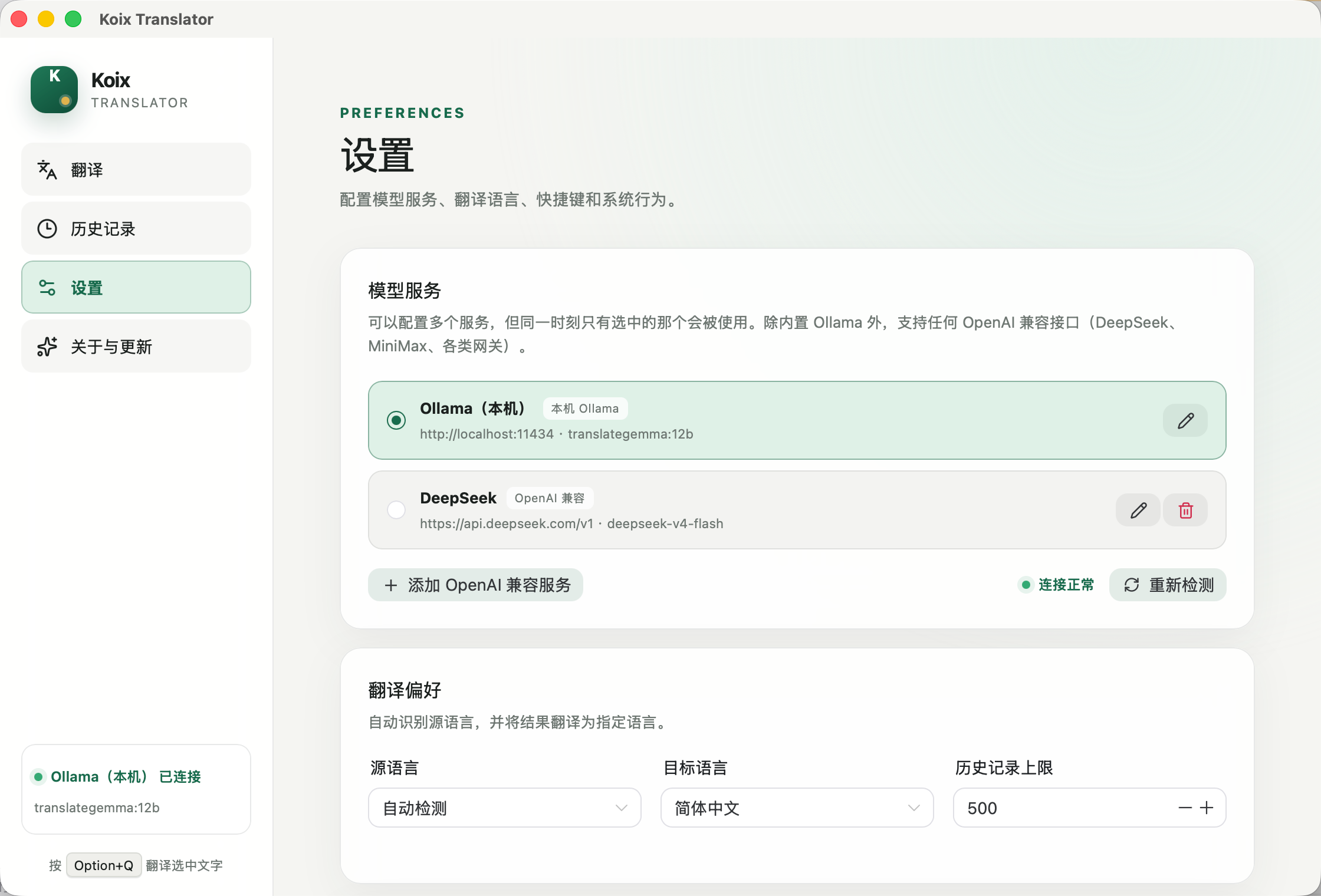
Everything below is implemented in the desktop build. The app ships no model of its own; translation runs on the service you select.

01Automatic capture
Finishing a selection pops the action bar above it; you can also turn that off and trigger it with Option / Alt + Q alone.
02Action bar and result panel
The bar sits above the selected text and expands into a result panel below it once you choose an action; the panel can be dragged and re-run.
03Translation and lookups
A JSON Schema constrains the output and the source language is detected automatically: lookups get phonetics and definitions, passages get the translation with their layout intact.
04Summary
Condenses the selection into one to three sentences in your target language, as plain text, and never written to history.
05Copy and read aloud
Copy the source or the result in one click; reading aloud uses the system speech synthesizer, with no extra network request.
06Multiple model services
Beyond the built-in Ollama you can add several OpenAI-compatible services, with common providers prefilled; connectivity and the model list can be probed before saving.
07Translation history
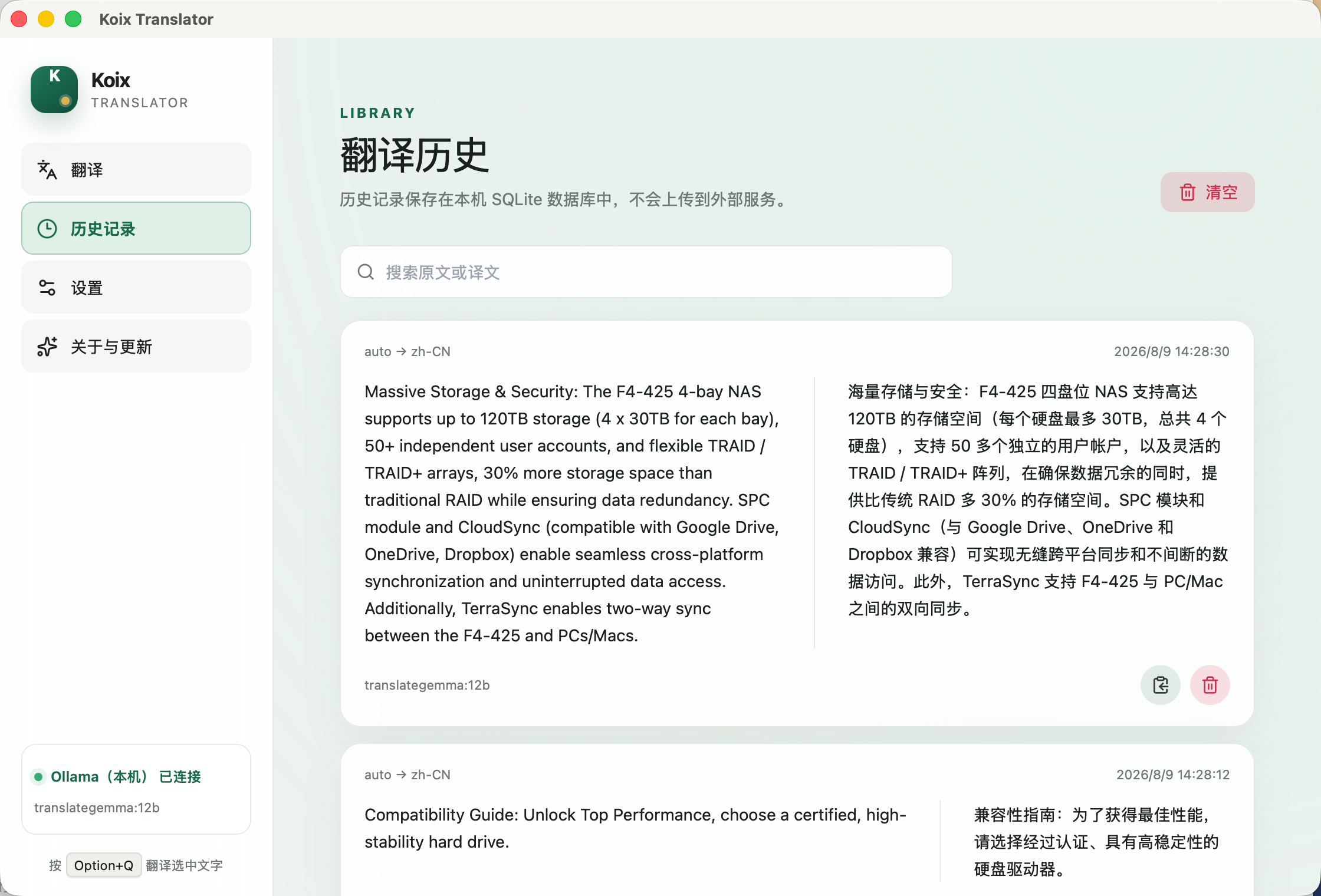
Source, translation, model, and timestamp are written to a local SQLite database—searchable, deletable, clearable, with long entries collapsed.
Boundaries

What it does not do

Both quality and privacy follow the choices you make. Here is what it explicitly does not promise.

  • No bundled model: a local Ollama has to be installed and running, and translation quality follows the model you choose.
  • Pick a remote OpenAI-compatible service and your text goes to that provider; choose the built-in Ollama to keep everything on the machine.
  • API keys and translation history are stored in plain text in koix.sqlite3; there is no system keychain integration.
  • macOS requires accessibility permission on first use; Windows requires the target app to expose the UI Automation text pattern, otherwise the clipboard fallback runs and restores plain text only.

Models

Give it a model first

The app ships no model of its own. These are the picks for a local Ollama, ordered by translation quality and footprint; a remote OpenAI-compatible service is not bound by any of this.

  • translategemma:12b

    Q4_K_M · ~8.1 GB

    Google’s dedicated translation model trained on Gemma 3, covering 55 languages. Its technical report shows a clear quality gain over the original Gemma 3 at every size.

  • translategemma:4b

    Q4_K_M · ~3.3 GB

    Google states that the smaller TranslateGemma sizes can reach the translation quality of much larger base models.

  • qwen2.5:14b-instruct

    Q4_K_M · ~9 GB

    Qwen2.5 handles Chinese, English, and other languages—the general-purpose choice if you would rather not install a translation-only model.

  • qwen2.5:7b-instruct

    Q4_K_M · ~4.7 GB

    For machines where memory is tight. Its Chinese tends to be steadier than most Western general-purpose models of the same size, though pure translation quality usually trails TranslateGemma 12B.

“A tool should wait beside the words you picked,
and where they go is your call.”

KoiX · Product principle 03

Next product

Continue to KoiX Homiary